Why I Fast
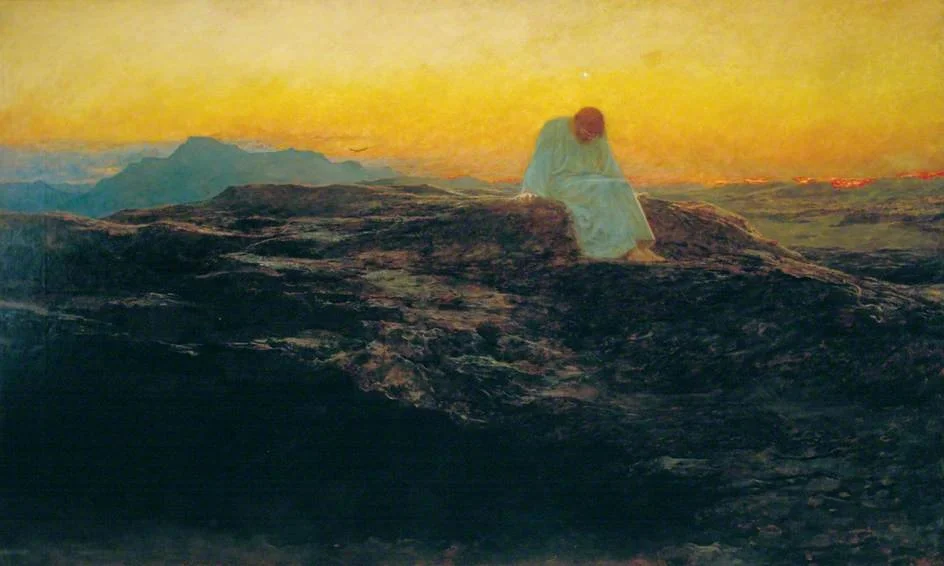
(The Temptation in the Wilderness, by Briton Riviere, 1898, Wikimedia Commons)

This year we're collaborating with writers across the Augustine Collective, a network of student-led Christian journals, to bring you a series of short devotional articles during this season of Lent, the 40-day period prior to Easter. Find this series also published by UChicago's CANA Journal and UC Berkeley's TAUG.
by robbie skinner, university of chicago
As Lent approaches each year, one thought never fails to cross my mind: What am I going to give up this year? And each year, the same few ideas come up: sweets, soda, or Instagram. This year, I felt that Instagram, reels in particular, was the most beneficial thing for me to give up. Yet, it had never crossed my mind to question why I fast in the first place, and perhaps more importantly, what my fast should look like.
I didn’t grow up in a family that fasted for Lent. It was never something that the church I grew up in talked about. Then sometime during high school, some of my friends started talking about it. Many told me they were giving up sweets, soda, or Instagram—the same things which I now choose from—and asked what I was going to give up. For some reason, I blindly went along with it. I told them sweets, and so that Lent I fasted from sweets. I never thought to ask why they fasted, or whether sweets were really something to be fasting from.
Looking back, I realize that my early attempts at fasting treated Lent like a personal challenge. Could I make it forty days without sweets? Could I stop scrolling reels? Yet, the more I have been reflecting this Lent, the more I have come to realize that the point is not simply to test my self-control. Fasting isn’t a test of strength, it's about revealing our weakness.
In Matthew 4, we see Jesus led into the wilderness to be tempted by the devil after fasting for forty days. The Gospel tells us, “And after fasting forty days and forty nights, he was hungry.”[1] After so long without food, alone in the desert and facing temptation, Jesus is in a place of physical weakness. What strikes me most about this scene is not simply that Jesus fasted, but rather that his fast brought him to a place of vulnerability.
Fasting has a way of doing the same thing for us. When we remove something we rely on, whether that be food, entertainment, or distraction, we begin to see how quickly we reach for those usual comforts. Our fast exposes our habits and our weaknesses.
Yet, the story in the wilderness does not end in weakness. In the midst of his hunger and temptation, Jesus responds with trust in the Father. When the devil tempts him to turn stones into bread, Jesus replies, “Man shall not live by bread alone, but by every word that comes from the mouth of God.”[2] His strength does not come from avoiding weakness, but from trusting God amidst it. For us too, fasting is not meant to make us stronger on our own. Rather, it serves to remind us how much we depend, or how we need to depend more on God.
Why then, do I fast? I do it because it helps me remember that my strength comes from the Lord. This Lent, as I reach for my phone to scroll reels, only to remember that Instagram has been uninstalled, my thoughts now turn to the Lord. In that brief moment of absence, where my mind searches for some comfort, I am reminded that the strength I need does not come from the things I seek, but from the Lord.
Robbie Skinner is a second year at the University of Chicago studying Law, Letters, and Society.
Sources
[1] Matthew 4:2 (ESV) Emphasis added.
[2] Matthew 4:4 (ESV)